

A New Era: the Lectrosonics S1 Shotgun and L1 Lavalier Microphones
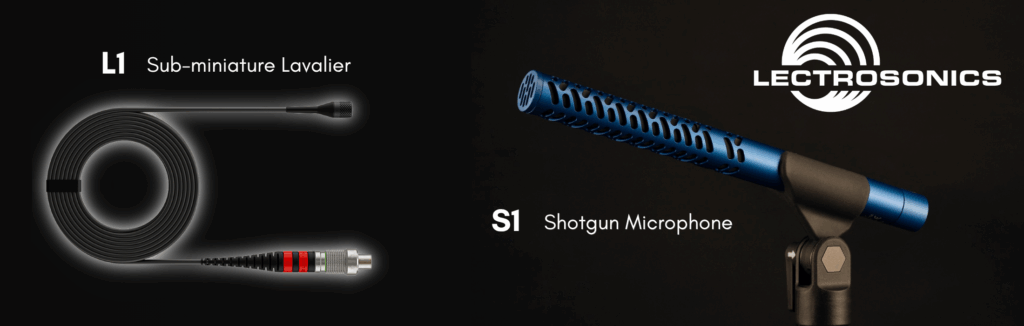
Lectrosonics microphones? Yes, Lectrosonics microphones.
The mad geniuses at Lectrosonics have spent more than fifty years making premier wireless systems. Their newly announced S1 shotgun and L1 lavalier microphones (both announced just ahead of NAB ‘26) mark a significant expansion into seemingly uncharted territory for the Lectro brand. But upon closer inspection, it makes a lot of sense. Let’s dive into a bit of how we get here, and of course, the specs of these new mics.
Røde Acquiring Lectrosonics
The location sound community paid close attention when the Freedman Group (the parent company of Røde) acquired Lectrosonics not long ago. Lectrosonics has always been a highly trusted name in professional wireless, and there was reasonable concern about what a change in ownership might mean for the brand’s direction. Well, we’re starting to get some answers, and so far, we’re more than pleased. Both of these new mics draw directly on Røde’s acoustic engineering and capsule technology, combined with Lectrosonics’ deep knowledge of what film and TV mixers actually need. Whether that combination delivers in practice remains to be heard directly (we’ll get our hands on a demo unit soon), but on paper the results are very compelling. And with the new IFBT2.0, it’s clear Lectro’s not abandoning their wireless devices.
Onto the mic details:
The S1 Shotgun
The Lectrosonics S1 is a short shotgun mic (8.4 inches long, 2.7 oz) machined from aircraft-grade aluminum and finished in a blue anodized coating, and it’s assembled at Lectro HQ in Rio Rancho, New Mexico. At 0.75 inches in diameter, it fits standard suspension mounts without needing to fuss with an adapter.
The S1’s capsule is a true condenser with RF biasing, which is the same approach used in the Sennheiser MKH series and widely considered to be the ideal design for location work. RF-biased capsules are inherently less susceptible to humidity than conventional DC-biased designs, which is a real-world advantage for exteriors, sweaty stages, and anywhere the weather might be less than cooperative. Self-noise is specified at 10 dB(A) and max SPL is 130 dB—strong numbers for a short shotgun in this category.
The line tube uses full radial symmetry, meaning the off-axis rejection and polar pattern are consistent regardless of how the mic is rotated in the blimp. This is an important detail for boom operators who don’t always have the luxury of perfect orientation. Current draw is under 2 mA from standard 48V phantom, which Lectrosonics specifically calls out for battery-powered mobile rigs. This is great for bag-based mixers who need to watch every milliamp.
Now in pre-order, the S1 is expected in the second half of 2026 at an MSRP of $1,639.
The L1 Lavalier
The Lectrosonics L1 lavalier mic is where things get genuinely new. Rather than a conventional FET-based capsule design, the L1 lav uses Røde’s Sonaura MEMS technology, which is a silicon diaphragm manufactured by the semiconductor company Infineon. Sonaura MEMS (Micro-Electro-Mechanical Systems) is the result of a five-year, $10 million R&D effort. While MEMS microphones are familiar in consumer electronics, bringing that fabrication process up to studio-grade performance is a different engineering challenge entirely.
This brings real practical benefits for mixers, namely consistency. Traditional capsule manufacturing involves physical diaphragm materials that vary between production batches, requiring sorting and matching. The L1 is specified at unit-to-unit matching within 0.5 dB in both sensitivity and frequency response. For a mixer running four or six lavs on a cast, that kind of repeatability is meaningful, so no one has to chase tonal differences between mics in post.
Noise specs are notable with L1: an EIN of 11 dB(A) and an 83 dB signal-to-noise ratio. Lectrosonics claims this is quieter than any other professional sub-miniature lavalier currently available. That’s a bold statement, but the numbers back it up if accurate.
Moisture resistance is another strong point. The Sonaura capsule is inherently hydrophobic, and Lectrosonics has added a specialized internal coating and 0.4 mm laser-drilled cap ports that provide pressure sealing. With all of this, the L1 mic is rated to remain functional when fully submerged. Paired with the IP57-rated DSSM bodypack transmitter, the entire assembly is waterproof, which has obvious implications for reality film, reality television, and outdoor productions.
When paired with the DSSM, the L1 also gains a switchable sensitivity mode that extends max SPL handling to 135 dB, useful for theater and live performance applications where levels can get extreme. The L1 maintains a 5.4 mm profile, uses a Kevlar-reinforced cable, and includes an ID ring system at the connector for quick on-set identification across a multi-mic kit.
The L1 is available now in black with LEMO connector. White, browQ n, and beige colorways, as well as a 5-pin connector variant, should be available later in 2026.
***