

Zaxcom DCiRX: A Different Breed of Zaxcom Receiver
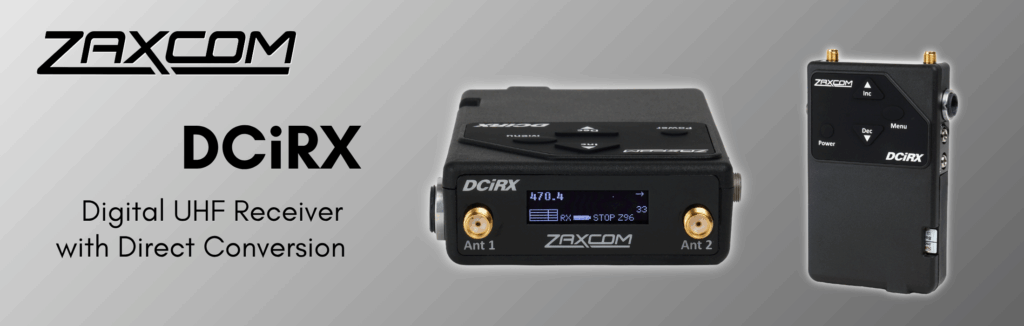
Let’s be honest. While we all love the technological wizardry of Zaxcom devices, they sometimes make it easy to get lost in their specs and their product iterations. But make no mistake, their new DCiRX receiver is a true generational advance. So we’ll break down the basics for you and cut right to the heart of what makes this receiver special.
DCiRX – Direct Conversion
The “DC” in DCiRX stands for Direct Conversion, and this is the crux. Every standalone Zaxcom receiver before the DCiRX one (the QRX200, QRX235, RX200, URX100) uses an intermediate frequency (IF) architecture, where incoming RF gets down-converted to a fixed IF stage before the analog-to-digital conversion. The problem with IF-based designs is that they digitize a wide swath of spectrum in one go. A strong off-channel signal (a walkie-talkie, a nearby TV broadcast, a rogue LED wall driver, etc.) can hit that wideband converter and degrade everything in the window simultaneously.
Direct conversion skips the IF stage entirely and applies a hardware filter per channel before anything reaches the A-to-D. Only your frequency arrives at the converter. The DCiRX also has a tunable front-end filter adjustable in 1 MHz steps, which is much tighter than the 35–50 MHz windows on earlier Zaxcom designs. In a crowded RF environment, that’s a meaningful difference.
To be fair, Zaxcom’s MRX414 module already delivers excellent RF performance with an ultra-low noise floor and strong interference rejection, but the MRX414 lives inside a host device. It needs a Nova 2, an RX-12, or an RX-4 to do anything. The DCiRX is the first time this class of receiver architecture shows up in a self-contained, battery-powered package.
This is where things gets interesting for location sound workflows, as Zaxcom didn’t just build a better standalone receiver. The DCiRX is a an upgraded receiver that also records.
The Four-Track Recorder
While recording capabilities have long long been baked into Zaxcom transmitters, no prior standalone Zaxcom receiver has ever directly recorded audio. Enter the DCiRX, which records four tracks simultaneously to a microSD card (three ISO tracks plus a mix track) in either 32-bit float or 24-bit fixed WAV, with SMPTE timecode embedded. That means a single unit on a camera or in a bag is capturing a timecoded backup of everything passing through it, without any additional hardware. The 32-bit float recording is particularly useful for ISOs: it gives you effectively unlimited headroom in post, so if the scene went louder than expected, you’re not clipping on the card.
The Mic Preamp
The DCiRX accepts a direct microphone input via a 3-pin LEMO (either 5V unbalanced for a standard lav bias, or 48V balanced phantom for a condenser), providing a legitimate plant mic channel. The ADC spec on the mic input is a respectable 117 dB dynamic range. Combined with the wireless channel, you have two sources going into one box, both recording to the same card with the same timecode.
USB-C Interface
The USB-C port on the DCiRX outputs four channels of digital audio simultaneously (the two wireless receive channels, the mic input, and the mix track) to a laptop, mobile device, or compatible camera. Zaxcom has made specific mention of compatability with Blackmagic ProDock, a clear signal of who they’re targeting with this feature. The DCiRX spec sheet lists its dynamic range at 144 dB, compared to 116 dB for the analog output, which is a meaningful gap and a good argument for going digital whenever your destination supports it. For anyone already routing audio into a DAW on a laptop on set, the DCiRX eliminates the need for a separate audio interface entirely.
IFB Mode
On top of all that, the DCiRX also functions as a UHF IFB receiver. So if you need it for comms monitoring rather than primary production, it handles that too.
What the DCIRX Replaces
The DCiRX can be thought of a consolidation device. A run-and-gun documentary mixer or a small single-camera drama unit might have previously needed a standalone receiver on the camera, a separate miniature recorder as a backup, a preamp for a plant mic, and a USB audio interface for the laptop. The DCiRX replaces all four. At 5 oz running on three AA batteries, it’s a lot of capability in a compact form factor.
Zaxcom’s QRX235 and RX200 remain the right answers for cart-based multi-channel setups, where you’re pulling eight or twelve transmitters through an MRX/RX-12 rig. The DCiRX doesn’t really compete with that workflow. But for those whose kit skews smaller and more flexible, this is the one you’ve been waiting for.
Finger crossed of course, but the Zaxcom DCiRX should be shipping imminently.
***