
Glensound Charles Interpreters Box
- Single-user interpreter’s unit for Dante and AES67 networks
- Three monitor inputs and two talk outputs with automatic ducking
- Redundant power and network connections
$2,375.00 USD
Glensound Charles Interpreters Box
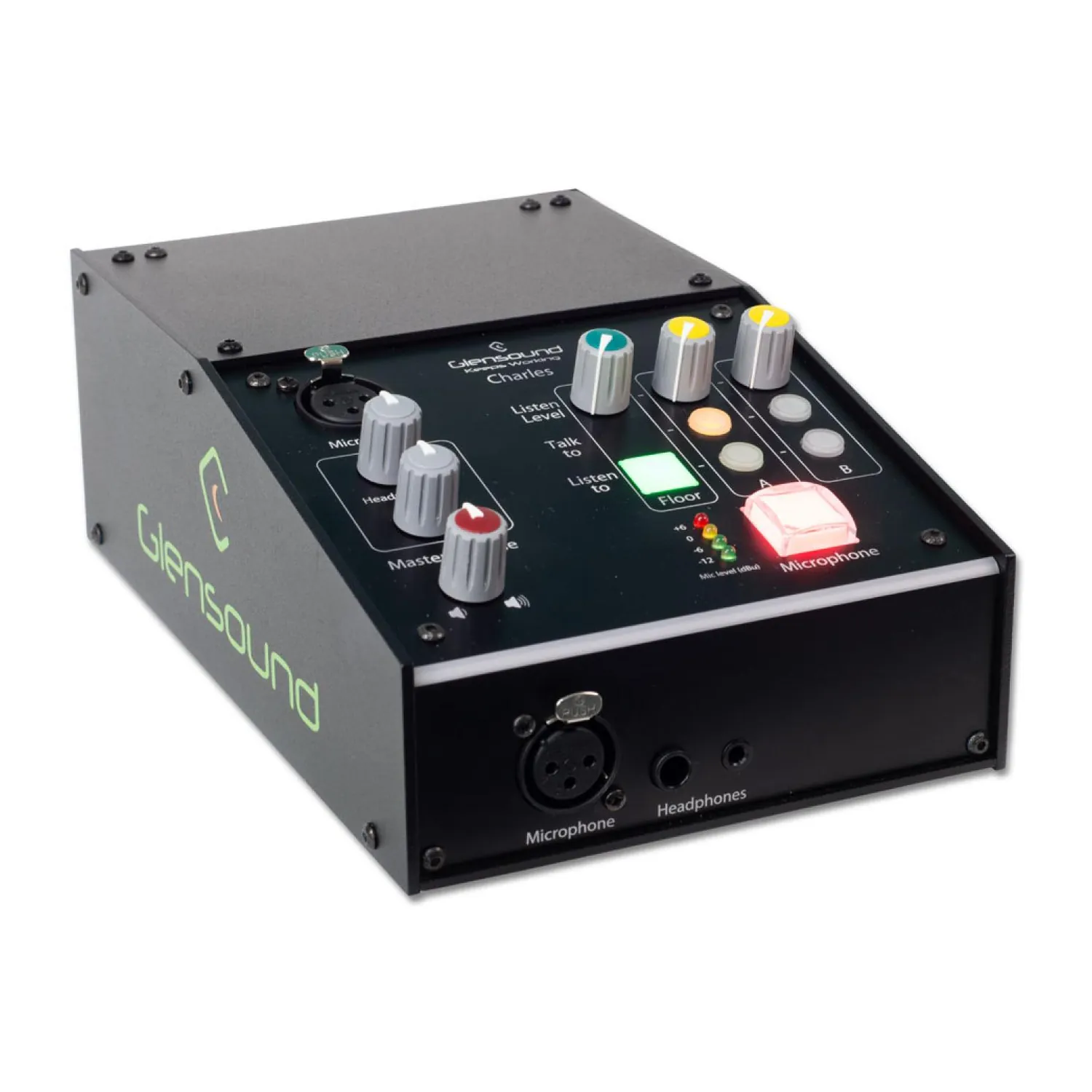
The Glensound Charles is a single-user box for interpreters working on a Dante or AES67 network, with three monitor inputs, two talk outputs, and automatic ducking.
It is built for live on-air broadcast, with four power sources: mains, external DC, and PoE on each of its two network ports. Its primary and secondary network connections are fully redundant, on copper RJ45 and SFP fiber.
Microphone and Headphones
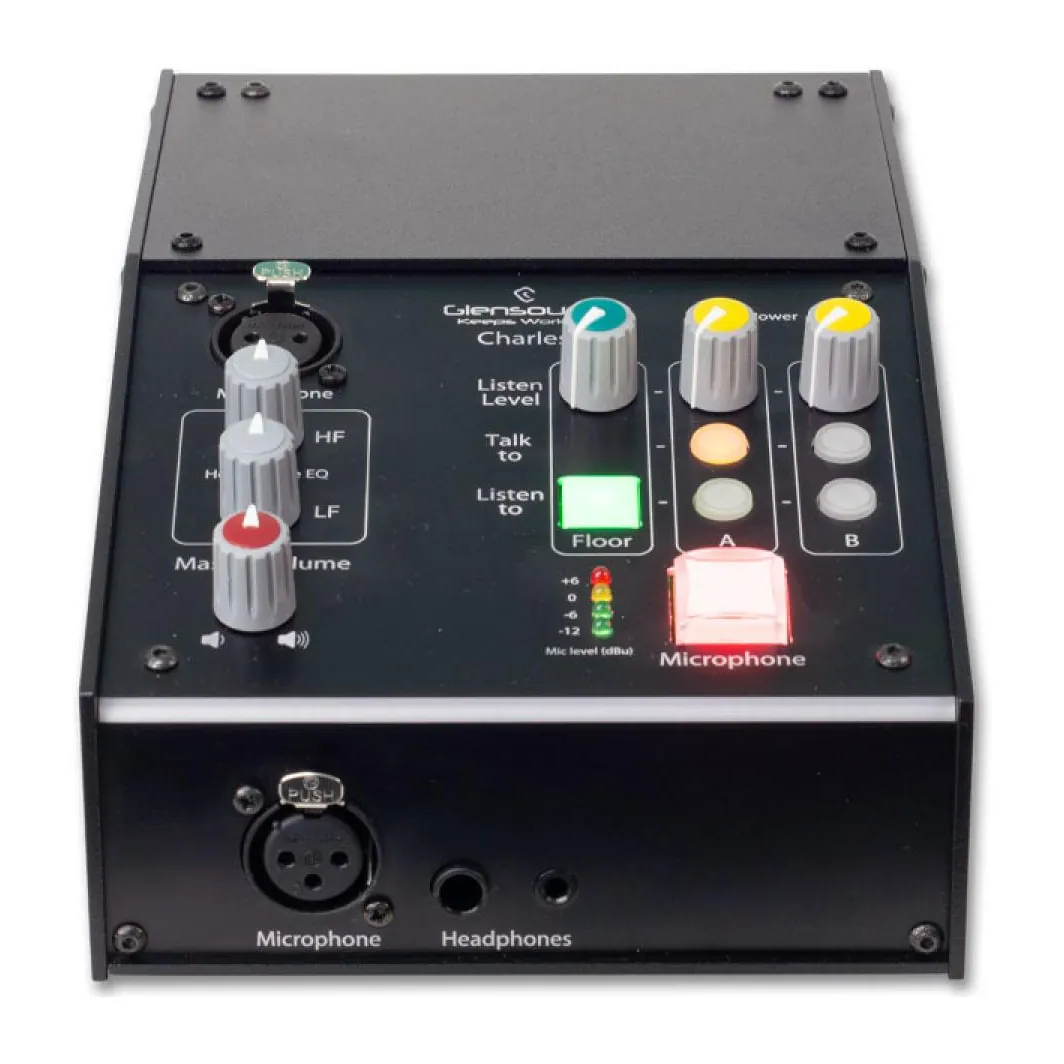
A broadcast headset connects through a 3-pin XLR mic input and a 6.35 mm headphone jack. A separate microphone and headphones work too. A 3.5 mm jack takes in-ear headphones or earpieces, and a gooseneck microphone plugs into a second XLR input on the top panel. One microphone is used at a time.
The headphone amplifier matches its output level to the headphones, so the volume control gives a consistent level across headphones and headsets, stereo or mono. Full-size knobs set the overall headphone level and a two-band EQ, which brings out the speech being interpreted.
Monitoring and Talk Controls
Three network inputs are available to monitor: the floor and inputs A and B. Each has its own level control, so all three can sit at the same level in the headphones. Pressing a source selects it and drops the one before.
The large, lit mic button works as a cough button (mic on, muted while held), latching, or momentary (live only while held). A 4-segment LED meter shows the input level, so the interpreter can also see that the mic is on. Two more lit buttons send the mic to output A or output B, one at a time. Mic or line input, 48 V phantom power, and input gain are set on the rear panel.
Network Outputs
Outputs A and B each send three feeds to the network on separate channels, picked in Dante Controller. One is the interpreter’s mic alone, one sets the mic over the input mix at -40 dB, and one ducks the input mix to -40 dB only while the interpreter speaks. The ducked feed keeps the original speech in the program whenever the interpreter is quiet.
Features
- Three monitor inputs (floor, A, and B) with one-press switching
- Talk to output A or B with one-press switching
- Three network feeds per output, including automatic ducking
- Cough, latching, or momentary mic button
- XLR mic inputs for a headset or gooseneck microphone
- 6.35 mm and 3.5 mm headphone jacks with a two-band EQ
- Adjustable sidetone level
- Mains, external DC, and PoE on either network port
- Redundant network connections on copper RJ45 and SFP fiber
What's Included
- Glensound Charles interpreters box
- RJ45 network cable (2 m, Cat5)
Specifications
| Network | Dante, configurable for AES67; 2 x Neutrik etherCON RJ45 (Cat6) and 2 x SFP slots, fully redundant primary and secondary |
|---|---|
| Sample Rate | 48 kHz, 24-bit |
| Control and Routing | Free Dante Controller software |
| Network Outputs | 3 each for outputs A and B: mic only; mic mixed with the input at −40 dB; mic mixed with the input, auto-ducked to −40 dB |
| Mic Input Gain Range | −30 dB to +15 dB |
| Dynamic Mic Line-Up | 58 dB |
| Mic with Phantom Power Line-Up | 35 dB |
| Line Input Line-Up | 0 dBu (gain range ±15 dB) |
| Mic Input Impedance | 2.4 kOhms |
| Line Input Impedance | 100 kOhms |
| Maximum Input Before Clipping | Dynamic mic +10 dBu; mic with 48 V phantom +18 dBu; line +18 dBu |
| Frequency Response | Mic: within ±0.25 dB, 50 Hz to 22 kHz (−2 dB at 25 Hz); line: −0.1 dB or better, 22 Hz to 22 kHz |
| THD+N (ref +8 dBu) | 0.023% at 100 Hz; 0.012% at 1 kHz; 0.014% at 10 kHz |
| Maximum Headphone Output | +16.8 dB into 600 ohms |
| Headphone Frequency Response | 22 Hz to 22 kHz (−0.1 dB or better) |
| Headphone Noise | −76.6 dB at line-up (residual) |
| Headphone THD+N | 0.008% at 1 kHz |
| Headphone Volume Range | +10 dB to off |
| Headphone EQ | 2-band |
| Mains Power | Internal supply, filtered IEC, 100 to 240 V AC (±10%), 47 to 63 Hz |
| DC Input | 2.5 mm barrel, center positive, 9 to 15 V |
| PoE | On either network connection |
| Power LED | Blue |
| Dimensions (W x D x H) | 137 × 210 × 86 mm (5.39 × 8.27 × 3.39 in) |
| Weight | 1.25 kg (2.76 lb) |
| Construction | All-aluminum, anodized and laser-etched, powder-coated sides |