

Different Economy, Same Response
 Like most in this business, I started with desire, gradually adding clients and then equipment. After renting everything at first, I eventually bought my first pieces in 1980: a microphone (Sony ECM-50) and a mixer (the “new” Shure M-267). I’m better off because of the investment, so it was money well spent. And I still have them both.
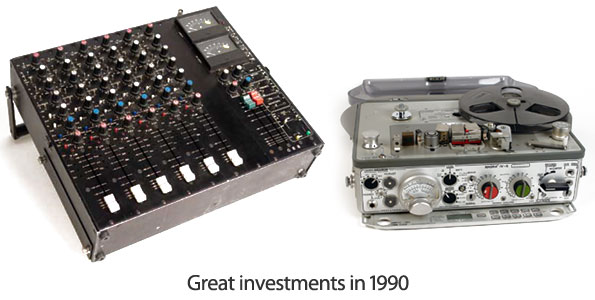
Often, when I’m talking to someone who’s trying to decide between one mixer or another, or one microphone or another, etc., I look back over my years as a freelancer and tell them my experience: I have never regretted buying the best I could afford when I needed it, but there have been many times that I regretted buying things based on low price, many of which made a loud thud when they entered the dumpster. Using a simple rule described below in this article, in the early 1990’s I spent a scary amount of money on a new Cooper 106 ($10,000) and a new Nagra IV-STC ($13,000). As it turns out, these were two of the best investments I’ve ever made.
Well, it’s nearing the end of 2008 now, and it is common knowledge that, yet again, after a run of five or six good years, the economy around the world is slowing, even receding. As has always been the case, things will turn around, but the general sentiment is that the lull may stay for a while-six months, a year, maybe a couple. Everyone knows that this is the current problem, but what may not be so clear to film/video sound professionals is how to best respond for their careers.
I’ve been in the business of sound for film and video production long enough to experience many cycles of economic downturn and recovery. Over and over again, I’ve witnessed what have proven to be wise responses and poor responses to both good and worrisome times. The patterns have been so consistent that surely the same principles that influence your degree of success or struggle will apply this time around, too.
One decision all freelancers in this business must make is what equipment to buy and when to buy it. When making these decisions, we are all basically attempting to achieve the best balance between low exposure to financial risk, and an increased probability of career stability and advancement. Regarding the economics of buying equipment, I have come to believe that the proper response during the good times is the same as the proper response in the worrisome times: Buy the best you can, when you need it.
Some work on Wall Street. You work in sound. Imagine what would happen if a brilliant financial analyst with years of success “reading” the market sat down at your cart or strapped on your equipment and attempted to do what you do. They might kid themselves into thinking anyone can do it, but as we all know, the unlucky dude would gain a new perspective of the term crash. Likewise, don’t kid yourself into thinking you can do what they do. The two professions are very skilled and very different.
As the owner of Trew Audio, I’ve observed now for 25 years the buying decisions of countless sound professionals. There are undeniable buying patterns associated with those who go on to great success and those who struggle, though they all have the same goal of improving their careers by spending their money wisely.
 Some pursue this goal by trying to out-smart the constantly changing market by buying at “just the right time”-fearing that the price may go up, waiting until the price goes down, holding out for the next revision, buying things from another country because their currency is favorable, etc. With this “timing” approach, there are three problems that negatively impact careers: First, it directs the buyer to either act before they have the need, or to do without equipment for a time when they need it. Second, it lures the buyer toward equipment that may not be the best choice for their needs. Still, you might say that the dollar is important enough to consider such compromises, which, of course, is a fact of life. But the problem is that you can’t reliably time a complex market where every facet is beyond your control. So, the third problem is that the buyer is just as likely to mis-time the market as they are to “nail” it. In the long term nothing will have been gained, and the costs are either not having what is needed at the time, or paying for equipment when it isn’t needed. Do the math: -1+1=0, -1-1=-2. Of course, there’s no accounting for luck, but on average, this method has nothing for it and two strikes against it, which is consistent with my observations over the years.
Then what to do? Our original rule, Buy the best you can, when you need it, answers the most important questions: What to buy? & When to buy it? Sticking with this philosophy over the long haul absolutely will improve your career and financial standing. For example, once you determine what to buy, and you then buy it independent of market fluctuations (when you need it), the law of averages assures that you will buy when the market is high just as often as you will buy when the market is low. In other words, using this method over the length of your career, you will not spend any more money than if you try to time your purchases with a moving market. You will have the best equipment you can have, when you need it. An indirect advantage to this method is that all the energy saved from something in which you are not an expert (predicting a constantly changing market) can then be focused on what you do know about (sound for your clients), which results in what your envious competitors will scoff at as “lucky breaks.” Hey, maybe there is some accounting for luck, after all!
 There are what might seem to be some exceptions to this rule. For example, if a piece of equipment is known to be needed in early 2009, tax considerations might be a valid reason for buying at the end of 2008 to take advantage of applicable tax laws. But this is really not an exception to our rule, because tax laws are a known factor (at least by your accountant). Another example of what seems to be an exception is when a future price increase is announced. This happened with Schoeps microphones a couple of years ago, and many took good advantage of it. Likewise, Sonosax has just announced that their prices will increase by 3%-5% in early 2009. So, in the case of Sonosax, if you have already decided to buy a piece of Sonosax equipment for a project in early 2009, it might make sense to buy a bit early to avoid the 5% increase. You might ask, “what about the exchange rate risk?” Well, it’s true that Sonosax prices are always based on the Swiss franc, and, as is the case with many items made outside of your own country, local prices will fluctuate with your local currency. But the exchange rate risk is always in the equation (sometimes you win, sometimes you loose), whether you wait or not. So if the timing fits your need, acting on an announced price increase is a known benefit and, therefore, not an exception to our rule.
Summary
Like most things simple, the rule, Buy the best you can, when you need it, works. It has worked for me, still does, and always will. Adopt this philosophy and apply it to the next purchase you are considering, and the next, and the next, and you will be in an ever-improving position to best use what got you started in the first place-your desire to work in sound.

Sometimes you win, sometimes you LOSE (unless you’re Archie Bell)
Nice article Glen. One other consideration with today’s new equipment, (not the usual stuff like mikes or fishpoles,) should be the learning curve. For example, buying a digital recorder a week before a job can be risky. Is it working properly? Can you even tell if you haven’t learned the basics of its operation? Do you have all the cables needed and are they wired right? Just like being early for a call is being on time, buying equipment early is being prepared.
Great advise Glen, Thanks for your willingness to share your years of experience with us. I have made few bad buying decissions in the past that I wish I had just listened to John Algee’s advice and bought the right stuff the first time around. I would have saved a lot more money doing it your way. But in the end, I’ve learned and I’m better for it now.
Again, thanks
Chas
Thanks Ed, but “loose” is correct. The typo was the preceding “you” which should have been “you’re”. 🙂
Dale, that’s a good point (about time needed to become familiar with new equipment). The concept basically boils down being prepared, which, of course, is a good idea when you can. However, the problem a lot of sound mixers face is that they often find themselves needing new equipment with very little time before having to use it because they are often hired for productions with very little time to prepare. For this reason, it may be more common than it should be that sound pros wait until the very last minute (waiting until the job is certain) to buy new gear. The practice is understandable, and maybe even at times advisable. But when the need to add new equipment is relatively certain (such as in the case of those established in their careers), it is better to buy it in plenty of time to learn it and to work it into your system.
Thanks Chas. We may not get it right every time, but we try to, every time.
As we are refining this blog portion of the Trew Audio website, please feel free to suggest topics, either by adding a comment to a thread or by contacting me or the other authors directly.
Regards to all,
Glen Trew