

New Rycote for the Sennheiser 8040/8050
A new suspension and windscreen for the Sennheiser MKH-8000 microphones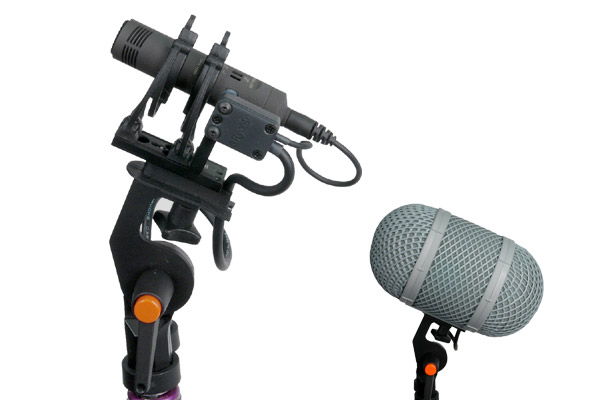
Pricing:
Rycote is a respected and innovative manufacturer of high quality microphone windscreens and suspension systems. So when they saw the Sennheiser MKH-8000 compact microphone series and its potential for film and video use, they developed a system that not only isolates the microphone from wind and boompole handling noise, but also makes the microphone even smaller and lighter.
The challenge is the Sennheiser 8000’s extended low frequency response that goes to the very bottom, which also makes them sensitive to rumble as low as 10Hz and even lower. The transformer inputs on the mic preamps of some older console designs might effectively muffle this sub-rumble, but the transformerless inputs typical of more modern designs transfer these low frequencies in all of their glory. To assist in controlling issues associated with ultra-low frequencies, Sennheiser offers a small filter model called the MZF-8000 that screws on between the capsule
and the XLR connector. (More about this filter module below.)
Using the MZF-8000 filter
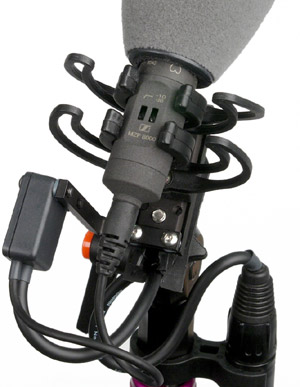
When the MZF-8000 filter is installed between the mic and the cable, and with the filter switch in the OFF position, the low frequencies are cut sharply below 20Hz. There is very little audible difference with the switch in the OFF position, but it can be noticed that artifacts caused by subsonic overload are significantly reduced. Using the filter in the OFF position is sufficient to eliminate internal resonance of the fully enclosed windscreen. When the filter switch is in the ON position, the low frequencies are reduced, more gradually (about 12dB/oct), from 200Hz. In the ON position, the low cut seem identical to the low-cut position of the larger MKH-50 and MKH-40. Using the filter in the ON position might be recommended when used outdoors to further reduce the affects of wind, and also if using the microphone closely, to reduce the added bass of proximity affect. But for interior use, I would normally use the filter in the OFF position. The MZF-8000 filter also has a 10dB pad that can be switched in to increase microphone’s maximum SPL ability (I’ve sometimes had to do this with the MKH-40 to prevent the mic from distorting when dialog levels got very high).
The Rycote System
Rycote’s system (Mono Extended Ball Gag MZL Suspension)for the Sennheiser 8000 microphones starts with their “Lyre” suspension, which does a great job isolating the microphone from handling rumble. For interior use, I’ve found that the Rycote Invision Lyre suspension alone isolates these ultra low frequencies very well when other traditional suspensions cannot. However, for exterior use (when enclosed wind protection is required) the Sennheiser MZF-8000 low cut filter module is absolutely required to keep rumble under control, due to the extremely low resonate frequencies of a fully enclosed windscreen. Adding this filter would normally make this compact microphone and windscreen system larger, so Rycote teamed up with Sennheiser and incorporated a low profile extension/jumper cable that replaces the microphone’s body and relocates the XLR connector outside the windscreen. The cable reduces the combined length of the microphone and cable connector from 6-1/4 inches to only 4 inches, which allows this very high performance microphone to be used in a fully enclosed blimp windscreen (Mono Extended Ball Gag Windshield) that is a total of only 7 inches long. (The additional 3-inches are for the required “dead air” space surrounding the microphone.)
It is important to note that this cable extension is not a traditional “active” cable such as the type other manufacturers have used between their mic capsules and amplifier/bodies. The difference is that the Sennheiser 8000 series microphone “capsules” are actually fully contained microphones, complete with internal amplifier and a low impedance balanced output. There are two reasons that this is an important distinction: 1. Traditional active cables between a capsule and amplifier/body are a high impedance circuit that is susceptible to induced noise, and require an amplifier/body module at the other end of the cable. 2. The Sennheiser 8000 series extension cable is effectively only adapting the microphone capsule to an XLR connector. Thus, it is simply a small microphone at one end and an XLR connector at the other–simple, balanced, and economical.
Making this new Rycote system even more attractive is its ability for very quick changes from interior to exterior setups, and back again, without having to remove the microphone. This is because the suspension inside the windscreen uses Rycote’s compact InVision Lyre system, which also happens to be an ideal choice for interior setups. To change from in an interior location to an exterior location (where more wind protection is needed), just loosen the knob under the suspension, slide on the windscreen, tighten the knob, then put on the back cap and furry Windjammer.
An important part of this windscreen and suspension system is what Rycote refers to as the “Connbox”. The Connbox is a small cable junction attached to the suspension that isolates the microphone connecting cable and locates the XLR connection outside the windscreen. This allows the microphone and suspension system to be disconnected from a boom pole without ever having to open the windscreen.
As manufacturing technology improves, smaller and lighter-weight tools for sound become the norm. This trend continues with the new Sennheiser MKH8000 series microphones, made possible for boom use by new designs from Rycote, working together to make yesterday’s favorites seem oddly large while keeping sound quality high.
Just what you would expect from the leaders.

how much are all the pieces?
Hi John, links to the prices have been added to the top of the page.
GT
Quick question, Glen, I think of the 8040 as an interior mic. With this setup, is the 8040 suitable for exteriors as well? Could it compete with a 416 outdoors? Or is that comparing apples to oranges?
So that explains why each capsule is priced as high as it is compared to the “system”! Where does the original MZK 8000 (the XLR / phantom power adapter) live in this arrangement? At the mixer input (if you’re working out of a bag) or at the boom op’s interface back to the mixer? The shockmount shown above has a different rear lyre than the one shown on the MZL suspension page. Can one specify which lyres one gets? I try to achieve multiple purposes when I can with my gear to be frugal. This system would be perfect as a zeppelin system for, say a Sanken CS-1, or a Neumann KM-184, if there was simply a longer middle section of the windscreen available. Could this be a direction they’re going?
Hi Jim,
Yes, when used with the Rycote system described above, the Sennheiser MKH-8040 and MKH-8050 can be used successfully for exteriors, like other short microphone such as those from Schoeps (MK-41) and Sennheiser (MKH-40 and MKH-50). In my opinion, the benefits of using short microphones outdoors is often overlooked, particularly in natural outdoor settings for dialog and acoustical music.
While the off-axis rejection in the voice range is well known with shotgun mics like the 416, keep in mind that longer mics (shotguns and short shotguns) do not reject off-axis low frequencies as well. This is why the low freq roll-off is a nonadjustable feature of the 416. However, short microphones like the 8040 reject the low frequencies more evenly, allowing the capture of more natural ambience.
It occurred to me that I didn’t include enough detail about the MZF-8000 filter, so I added the section called “Using the MZF-8000 filter” to the article today (Nov. 11). So you might want to read that section.
Glen Trew
* * * * *
Gee Ell said on November 11th, 2009 at 3:43 pm:
…So that explains why each capsule is priced as high as it is compared to the “system”! Where does the original MZK 8000 (the XLR / phantom power adapter) live in this arrangement? At the mixer input (if you’re working out of a bag) or at the boom op’s interface back to the mixer?…
* * * * *
Hi Gee,
Yes, the XLR module of the MKH-8000 series is really just a connector (no active components), so, at about US$200, it is much less expensive than the mic capsule module.
When using the MKH-8040 or MKH-8050 in the Rycote system, the XLR module is not used because it is replaced by the Connbox cable assembly. In fact, adding the XLR module to the mic module and filter module would make the mic too long to fit into the Rycote windscreen, which is why the Connbox is needed to keep the system as small as it is.
Good eyes about the clip being different on the MZL page of our online store! The MZL suspension includes three clips, one of which is a very small diameter to clip onto the cable (as shown here: http://www.trewaudio.com/store/product.php?productid=1046).
If using the MKH-8040 or MKH-8050 with the MZL suspension indoors (without the zeppelin style windscreen), then the MZF filter module is not needed, and therefore the small clip for the cable is used. But if the intention is to also use the 8040/8050 in exterior location (thus requiring the windscreen and MZ-8000 filter) I’ve found it better to use the larger rear clip as shown in the photo in the above article.
I still do about one movie per year and the occasional commercial, and when I do, my MKH-8040 will be rigged as in the photos above, always ready for interior or exterior windscreens.
Glen Trew
Glenn: I always tend to use more directional mikes than wider ones,to have a better isolation from background ambience, so I’m very interested at the MKH8050. Can you compare it with the 8040 and 416 or even a MKH 70? I also would use it for interiors and exteriors.
Hi Glen. Is that a Schoeps foam? (3rd picture)
Maintain the great work.
Is there a way to mount this on a camera like with the invision serie?