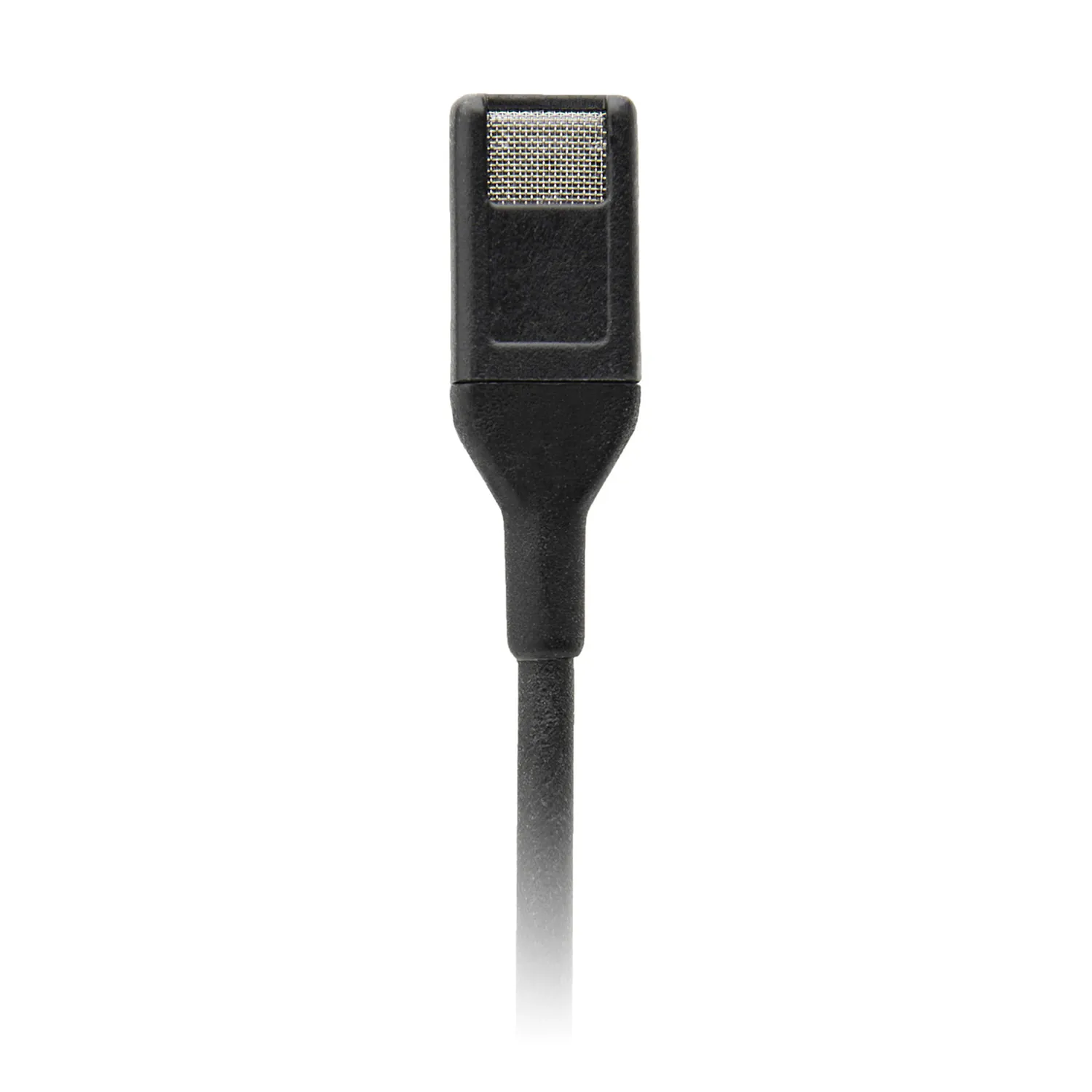
Countryman I2 Instrument Microphone
- Tiny instrument microphone with precise polar patterns and deep nulls
- Four patterns, standard or high gain
- Wired for your transmitter or an XLR input
From $261.75 USD
Countryman I2 Instrument Microphone
The Countryman I2 is a tiny instrument microphone. Its pattern control and frequency response hold at all angles, for uncolored recordings and fewer feedback problems.
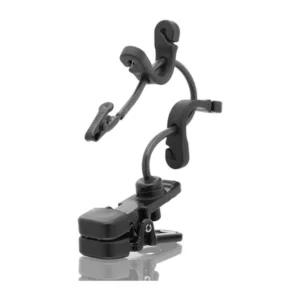
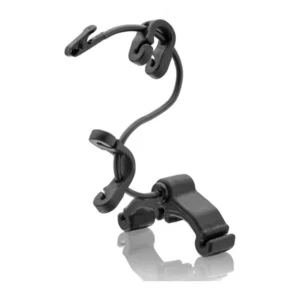
Small size and sonic precision make the I2 a fine choice for X-Y, M-S, and other techniques that rely on accurate coincident positioning and consistent patterns. The tiny size also suits distance miking that stays invisible on camera. Countryman’s instrument mounts open up close miking, holding the microphone securely and gently on strings, brass, and more, so the pattern can be aimed to capture the natural tone of the instrument.
The omnidirectional version picks up sound equally from all directions. It has the flattest response and the lowest noise, it is the least affected by wind noise and vibration, and it is often used on percussion, guitar, saxophone, and piano. The cardioid picks up about a third less ambient noise than the omni, so a performer can stand about 1.7 times as far away. Use it when the microphone can face the source directly and unwanted sound, such as a crowd or a loud monitor, is behind it.
The hypercardioid has a narrower front pickup and better rejection, with a working distance about twice the omni’s. Its strongest rejection is about 60 degrees off the rear on either side, so it is the best choice when the loudest unwanted sounds, such as speakers, can sit at those angles. The bidirectional version, a figure-8 pattern, picks up sound equally from two directions and is commonly used in mid-side recording.
Every pattern comes in two sensitivities. Standard gain is made for close miking and loud instruments such as horns, and it handles up to 150 dB SPL. High gain adds sensitivity for distance miking and for capturing detail in quieter instruments, and it handles up to 130 dB SPL.
For a grand piano in mono, attach an omni I2 facing the lid near the center board with double-sided foam tape, or set it over the strings on a mic stand. For stereo, set two cardioids on edge 1/8 in apart, facing left and right, with the lid open 3 to 6 in. On an upright piano, try an omni on one of the central backposts. On a violin or viola, the I2 Violin Mount places the microphone between the bridge and tailpiece, pointed toward the body. On a cello or double bass, the I2 Bass and Cello Mount’s positioning arm allows positions under the bridge or over the f-hole, with the silver (active) side toward the body.
Each wireless version comes with a 5 ft cable that ends in the connector for a specific transmitter. TA5F fits Lectrosonics, and a 3-pin Lemo fits Lectrosonics SSM, Shure, Sennheiser, Audio Limited, Zaxcom, or Wisycom. The other choices are Sennheiser’s 3.5 mm locking plug and TA4F for Shure. The XLR version has a 10 ft cable and runs on phantom power from 6 to 50 V at 4 mA, and below 24 V the overload level drops. The Configurations tab lists the transmitters each connector fits.
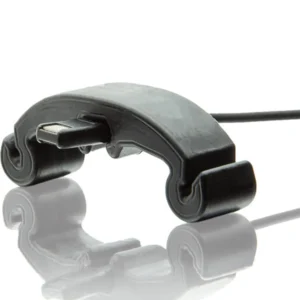
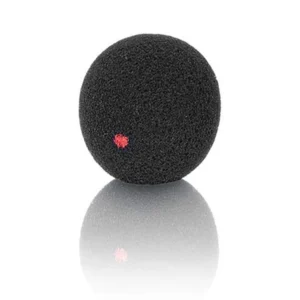
The I2 is black, and it comes with a windscreen, a basic clip, and a carrying case. Instrument, bass and cello, violin, guitar, flute, and stage mounts are sold separately.
Features
- Smooth frequency response, low noise, and precise polar patterns with deep nulls
- Cardioid, hypercardioid, omnidirectional, or bidirectional (figure-8) pattern
- Standard gain for close miking and loud instruments, or high gain for distance miking
- Small enough for X-Y, M-S, and other coincident techniques
- Tiny size for distance miking that stays invisible on camera
- 5 ft cable wired for your transmitter, or 10 ft to XLR
- Windscreen, basic clip, and carrying case included
Configurations
| Connector | Fits | Patterns | Gain | Cable Length |
|---|---|---|---|---|
| TA5F (Lectrosonics) | Lectrosonics LMa, LMb, LT, PDR, SMa, SMB, SMDa, SMDB, SMDWB, SMQ, SMQa, SMQV, SMV, SMWB, SPDR, and DCHT (with MCTA6TA5M2) | Cardioid, Hypercardioid, Omnidirectional, Bidirectional (Figure-8) | Standard, High | 5 ft |
| Lemo 3-Pin (Lectrosonics SSM, Sennheiser SK 2000) | Lectrosonics SSM Sennheiser SK 2000 |
Cardioid, Hypercardioid, Omnidirectional, Bidirectional (Figure-8) | Standard, High | 5 ft |
| Lemo 3-Pin (Shure, Sennheiser SK 5212/6000/9000, Audio Ltd A10) | Shure AD1LEMO3, ADX1LEMO3, ADX1M, AXT100LEMO3, ULXD1LEMO3, and UR1MLEMO3 Sennheiser SK 5012, SK 5212, SK 5212-II, SK 6000, and SK 9000 Audio Limited A10-TX and A10-TX-US |
Cardioid, Hypercardioid, Omnidirectional, Bidirectional (Figure-8) | Standard, High | 5 ft |
| Lemo 3-Pin (Zaxcom) | Zaxcom TRX900AA, TRX900LA, TRX900LT, TRX900LTH, TRX900LTHS, TRX900LTS, TRXFB3, TRXLA2, TRXLA3, TRXLT3, and ZMT3 | Cardioid, Hypercardioid, Omnidirectional, Bidirectional (Figure-8) | Standard, High | 5 ft |
| Lemo 3-Pin (Wisycom) | Wisycom MTP30, MTP40, MTP40S, MTP41, and MTP41S | Cardioid, Hypercardioid, Omnidirectional, Bidirectional (Figure-8) | Standard, High | 5 ft |
| 3.5 mm Locking (Sennheiser) | Sennheiser SK 100 G1 to G4, SK 300 G1 to G4, SK 500 G1 to G4, SK 1093, SK 20, SK AVX, SK D1, SK-XSW, SL Bodypack DW, and XSW-D TX35 Audio 2000’s AWX6030M |
Cardioid, Hypercardioid, Omnidirectional, Bidirectional (Figure-8) | Standard, High | 5 ft |
| TA4F (Shure) | Shure AD1, ADX1, AXT100TA4F, GLXD1, PGXD1, QLXD1, and ULXD1 | Cardioid, Hypercardioid, Omnidirectional, Bidirectional (Figure-8) | Standard, High | 5 ft |
| XLR (Phantom Power) | XLR inputs with phantom power (XLR3 male) | Cardioid, Hypercardioid, Omnidirectional, Bidirectional (Figure-8) | Standard, High | 10 ft |
What's Included
- I2 Instrument Microphone
- Windscreen
- Basic Clip
- Carrying Case
Specifications
| I2 Instrument Microphone | |
|---|---|
| Pickup Pattern | Cardioid, hypercardioid, omnidirectional, or bidirectional (figure-8) |
| Frequency Response | Omnidirectional: 20 Hz to 20 kHz Directional: 50 Hz to 20 kHz |
| Sensitivity | Standard gain: 1.5 mV/Pa (−56.5 dBV/Pa) at 1 kHz High gain: 10 mV/Pa (−40 dBV/Pa) at 1 kHz |
| Equivalent Acoustic Noise | Standard gain: 38 dB SPL, A-weighted High gain: 20 dB SPL, A-weighted |
| Overload Sound Level | Standard gain: 150 dB SPL at 1% THD High gain: 130 dB SPL at 1% THD |
| Output Impedance | 130 Ω at 1 kHz 250 Ω below 100 Hz |
| Power Requirements | Phantom, 6 to 50 V at 4 mA (reduced overload SPL below 24 V) |
| Cable | 2 mm Duramax, aramid-reinforced |
| Cable Length | 5 ft (wireless versions), 10 ft (XLR version) |
| Color | Black |