

A review of the Schoeps SuperCMIT 2U
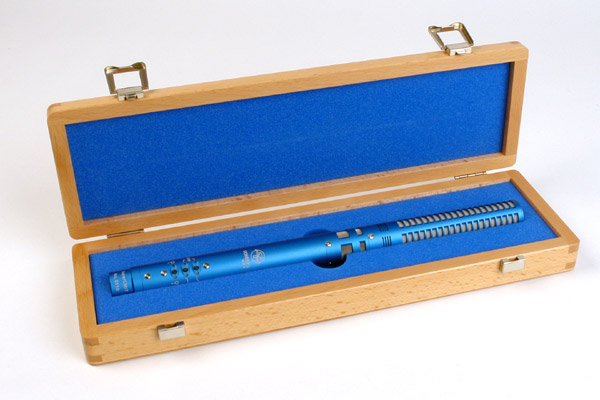
It’s a Super-Schoeps. But does it offer an improvement for film and video production? Yes, I believe it does. Since this, my first, evaluation of the Super CMIT was conducted at Trew Audio’s Nashville facility, and not in the more complex environment of a real production, I’m sure there is much more yet to be learned about pros and cons of this mic. But my first impression was, to my surprise, positive.
The SuperCMIT 2 U (hereafter referred to as just SuperCMIT) is a short shotgun microphone made by Schoeps, based on their successful standard CMIT short shotgun, with a very important difference: If you plug it into a standard microphone input, it will not work at all; The SuperCMIT is digital, and only has an AES output. Not only does it require a digital input, but it specifically requires an AES-42 type input, which, for film/video production, is currently only found on the Sound Devices 788T recorder. [Note: An AES3 input may be used in conjunction with a 10V phantom supply to power the mic’s digital circuitry. Schoeps is developing interface devices for using the microphone with traditional inputs. The Super CMIT can be used directly with Sound Devices 788T recorder, which has AES42 inputs]
For what we use boom mics in film and video production, is there really a good reason that this mic is digital? Yes. There are three:
First, the AES42 protocol allows the gain of the microphone’s internal processor to be controlled by the mixer’s input trim. Dramatic dialog has the most dynamic level changes of nearly any type of acoustic recording, so the input trim setting is crucial for proper signal without clipping. With the SuperCMIT, when adjusting the input trim on the mixer, you are actually adjusting the internal level of the microphone, optimizing gain structure where it matters most: at the microphone.
Second, since no analog audio is traveling along the microphone cable (it’s all digital data; ones and zeros), there is no possibility of induced noise into the microphone cable. This is an important advancement. Just like digital audio recording eliminated analog tape hiss, this digital microphone technology eliminates cable noise.
Third, creating the digital signal inside the microphone allows the SuperCMIT to do it’s real magic: The digital signal processor inside the microphone gives it more “reach”.
When first hearing about the enhanced reach of the SuperCMIT (the term “reach” actually refers to the bi-product of off-axis rejection – or, as Schoeps calls it, “diffused sound reduction”), I was skeptical. I remembered the Audio Technica 895, which was a surprisingly similar concept using digital processing to enhance its long-range ability. The AT895 was an idea ahead of the technology of its time, with sometimes amazing results, but unpredictable in its performance and unacceptable for high quality dialog. Fool me once, and all that…
But after listening to the SuperCMIT in situations we are likely to encounter as film/video production sound mixers, it proved to me that it is, indeed, a useful tool in capturing high quality sound at greater distances and in noisier environments.
Description:
Since AES signals actually carry two audio channels, Schoeps configured these two channels so that channel 1 is the “enhanced” signal, and channel 2 is unprocessed (essentially the same as the standard CMIT).
There is a switch for selecting two different degrees of digital processing. Position 1 is what most production mixers will choose most of the time. The processing is so transparent that it would go completely unnoticed unless comparing it with the unprocessed channel, with the only difference being that the processed channel’s off-axis sounds are about 5dB lower in volume. Position 2 of this switch gives another 4dB of off-axis attenuation, totaling an additional reduction of 9dB over the standard CMIT. This second position is not recommended (by Schoeps or myself) for normal high quality recording because of the occasional presence of audible digital artifacts, but rather for special situations when a degree of audio fidelity can be sacrificed in order to better hear certain sounds (referee calls amongst crowd noise during sports broadcasts would be an ideal occasion for this second switch position).[/vc_column_text][vc_row_inner][vc_column_inner width=”1/2″][vc_single_image image=”59316″ img_size=”medium” alignment=”center” onclick=”link_image”][/vc_column_inner][vc_column_inner width=”1/2″][vc_single_image image=”59317″ img_size=”medium” alignment=”center” onclick=”link_image”][/vc_column_inner][/vc_row_inner][vc_column_text]In addition to the processing switch, there is a low-cut filter switch with a slope of 18dB/oct. at 80Hz – ideal for voice and boompole use. There is also a switch to give a high frequency boost (5dB boost at 10kHz), intended to make up for high freq loss caused by thick furry windscreens. With a maximum SPL rating of 125dB (right where I would have asked, for dialog), thankfully, there is no need for an attenuation switch.
Two things really impressed me about the SuperCMIT when used overhead on the end of a boom pole. First, there was nothing objectionable about the processed sound. It was natural sounding around the axis and sensitive to the slightest transients, just like other Schoeps mics are famous for. But what really surprised me was that the digitally enhanced channel not only reduced the off axis sound of steady drone noise (such as air-conditioning rumble), but also instantaneous random off-axis sounds such as distant voices (this is where the older technology of the AT895 fell short). When using the SuperCMIT on a quiet dialog scene, there will be times where the AD will ask, for example, if you noticed the off-camera talking, and you can let them know that it wasn’t a problem.
When comparing one microphone brand or model to another, we often listen for differences so slight they could easily be imagined. But the difference between the SuperCMIT and a standard analog shotgun microphone is not slight at all. Anyone can hear the difference and realize the advantages.
Compared to other top-shelf shotgun microphones, the Schoeps SuperCMIT is definitely the most expensive. But does the cost make business sense? I can’t answer that for everyone, but I can say that it will give you an edge over colleagues who don’t have it, and often an edge is, indeed, what makes the difference in getting a job. With that in mind, calculate what might be lost or gained, and there’s your answer.
Summary
We use directional boom microphones to pick up voices at a distance by controlling the off axis ambience — shotgun microphones make voices sound closer than they actually are. The SuperCMIT allows us to record high quality dialog at still greater distances, or in higher ambient noise levels, or both. Does the SuperCMIT sound hugely different than the standard CMIT? Thankfully, no. But for what we use a shotgun microphone for, the SuperCMIT does more, and does it nicely.
Other manufactures will, no doubt, join in this new technology, which will, no doubt, continue to improve over time. Whether you join now or later, I predict that you will.

Hello soundmixers out there,
I also tested the new SuperCMIT, but I have a different opinion.
It’s trew, the off axis rejection is great, in noisy environments, it sounds even “cleaner” than a sanken lavalier.
But at the same time, I realized some problems (I’m not sure if there was a Problem with the SuperCMIT I used or if this are general problems:
1) The Talents voice became very thin. I guess this is caused by the fact, that low frequencies spread omni-directional (sorry, my technical english is not very good). So, low frequencies are catched up by the second membrane and are eliminated.
2) If you shoot in a noisy environment with the SuperCMIT, very small movements (we are talking about mm) of the Microphone cause huge changes in the Signal to Noise Ratio
3) My SuperCMIT’s sound was different to the sound i’m used to, when working with the CMIT5u. The SuperCMIT sounded more “digital” and had some kind of “light distortion” in the mids
As i already mentioned, perhaps my SuperCMIT had some troubles. And I’m sure that Glen has two of the best ears on this planet. But if I would ever use this Microphone, I would use it in a noisy environment. My Boom-Operator is really good, but for him it wasn’t possible to “work with the Boompole”, because small changes caused huge differences in Sound.
If you’re on an Interview, where you don’t have to move the Mic, the SuperCMIT would be the choice….but on features? I’m not convinced yet. Perhaps some Software-Updates can fix those Problems.
Danny
Hi Danny,
Thanks very much for your opinion and for describing your experience with the Super CMIT.
I’m curious to know what switch positions (1-enhanced, or 2-very enhanced) you had these anomalies with, and if you experienced them with just channel 1 (processed) or also with channel 2 (unprocessed). Switch position 2 is recommended only in severe circumstances when the audible digital artifacts are justified by the needed increase in intelligibility.
My evaluation was in an environment typical of an office setting, with air-conditioning rumble and people milling about in the background, which we often experience when shooting away from a sound staqe in real locations. In this setting, i found this new mic to offer easily noticeable improvements in reducing unwanted off-axis sound.
Assuming that your experience was with switch position 1, and using AES output channel 1, I’m wondering if the thin voice quality you perceived may have been the result of reduced off-axis low frequencies. This is definitely the case when comparing the Sanken CS3e to traditional shotgun mics (the CS3e reduces off-axis low freq more than traditional shotgun mics, giving the illusion that it lacks low freq response).
Thanks again, and I’m looking forward to your response.
Glen Trew
Hi Glen,
I had a very difficult set. There was a Video-Wall in the background (about 12×8 Meters) with a lot of fans.
I started with switch position 2 but the sound was not acceptable for me. So I changed to switch position 1. The Boom Operator and me decided to boom with an angle of 90 degrees. This was caused by the fact, that small changes caused huge differences in S/N Ratio (as I already mentioned), wich would cause huge problems in editing
I compared the unprocessed an the processed channel and the sound was much thinner on the processed channel.
The difference in Sound (compared to the CMIT5u) was also noticable on the unprocessed channel (sounding a bit like a light distortion in the mids)
It could be, my ears need to learn how a digital microphone sounds….
I listened to my recordings after the shoot in my studio and I heard the same issues, I heard on set (processed channel thin and light distortion in the mids, unprocessed channel with light distorting mids).
The advantage of the SuperCMIT is, that it reduces even the off-axis bass. Off- axis mid and high tones can be eliminated “quite well” with any other shotgun microphone.
And here is the Problem: If the Post- Production has to adjust the basses (boost it to make the voice sound natural), one of the “big” advantages of the SuperCMIT seems to get lost.
The thin-nes of the voice (and it was a female voice) was so obvious, that there must have been a problem with my specific mic….I’am sure, you would have heard it, if your mic had the same behaviour.
What do you think about my statement, it will be hard to “work” with the boom?
Danny
Of course, it will take more than my first evaluation of this new Schoeps to get a full understanding it.
Danny, your experience of the “thinness of voice” was evidently a real issue for you, which, because I did not notice this characteristic with the microphone I used in my evaluation, would suggest a faulty microphone.
Your comment about the ambience changing with microphone movement is very interesting. One reason I would not have noticed this is because, for the sake of consistency, I chose to lock the microphone in position overhead. However, while non-processed microphones don’t have a brain to trick, the Super CMIT does have a brain, and as we all know, boom microphones normally move as the actors move, so we need a test to see if your experience can be duplicated. Demo mics are currently in short supply, but I’ll test this microphone again as soon as possible with your experience in mind and post the results.
Glen
I am researching a cycle of short radio pieces about microphones for a general, international audience, and one is about any latest technology coming out of Germany. This mic (via your review) was brought to my attention by an excellent sound recordist/ DOP with a lot of features and documentary experience. I am not a sound technician, but work with doc filmmakers and in radio (as a journalist).
My question: do you see any indication that the SuperCMIT will reduce the need for ADR especially in costly fiction features? Here (Germany), sound designers/editors telll me they are often required to trash large amounts of on-set dialogue and re-record (add up actors’ fees, studio, professional fees, and the like), even on very professional films when the on-set sound-recording team knows what it’s doing. In theory it could, but is it so in reality?
Danny’s issue with moving the mic (thank you for raising it): we are also looking at how to improve independent documentary that isn’t shot in a controlled studio-type environment, especially when the talent is in a busy environment, the shot is a bit wide, ADR is not desired or possible, and yet you want to avoid that too-close sound of the lapel mic (or simply can’t mic up everyone). Sometimes you also don’t want the camera too close because it feels intrusive for the talent, but still want their voices to sound clear and not too ‘close’ relative to the look of the shot. It sounds from your review, like the mic can be much further away from the talent than a traditional set-up, which has implications for how wide the shot can be. Thank you very much for your contributions!
Hi Jo-Anne,
While the Schoeps CMIT 2U does reduce off-axis sound, and, therefore can enhance a voice in noisy environments, it cannot eliminate off-axis completely. Generally speaking, the improvement in off-axis rejection is similar to the difference between a cardioid and a supercardioid, or a supercardioid and a short shotgun.
In my opinion, consideration given to locations and camera setups is still as important as before.
Thank you, Glen.